- Kini AI
- Posts
- Responsible AI: Nigeria’s Next Chapter
Responsible AI: Nigeria’s Next Chapter
The InnovateAI 2026 Recap

Olayemi Oluwakorede
February 27, 2026

You know how it is when that babe finally says yes to all your toasting and decides to go on a date with you. You're on your best behavior. You wear your crispest native. You spray eleven body mists and perfumes. You dish out many shiny promises. I will take you to Zanzibar. I will spoil you with my money. I will do this and that. You do all of these in the hope of securing a second meeting.
For a few years now, that is exactly how we’ve been talking about Artificial Intelligence (AI) in Nigeria.
The air has been full of billion-dollar valuations and bold declarations that we are on the edge of a technological revolution. Everybody was saying different dramatic things, with some of the most repeated ones being, "AI will take your job", "AI is taking over the world", etc. Conference stages have echoed with predictions — heavy on what could happen and lighter on what is already being built and stress-tested within the Nigerian context and reality. The excitement has been undeniable, but the depth very inconsistent.
However, during our team’s coverage of the InnovateAI 2026 Conference in Lagos, we sensed a change in the wind. It became clear that the honeymoon phase is drawing to a close. In the words of Ehia Erhaboh, co-founder of the AI in Nigeria Foundation and co-convener of the conference, the conversation is shifting from the “wow!” to the “how?”.
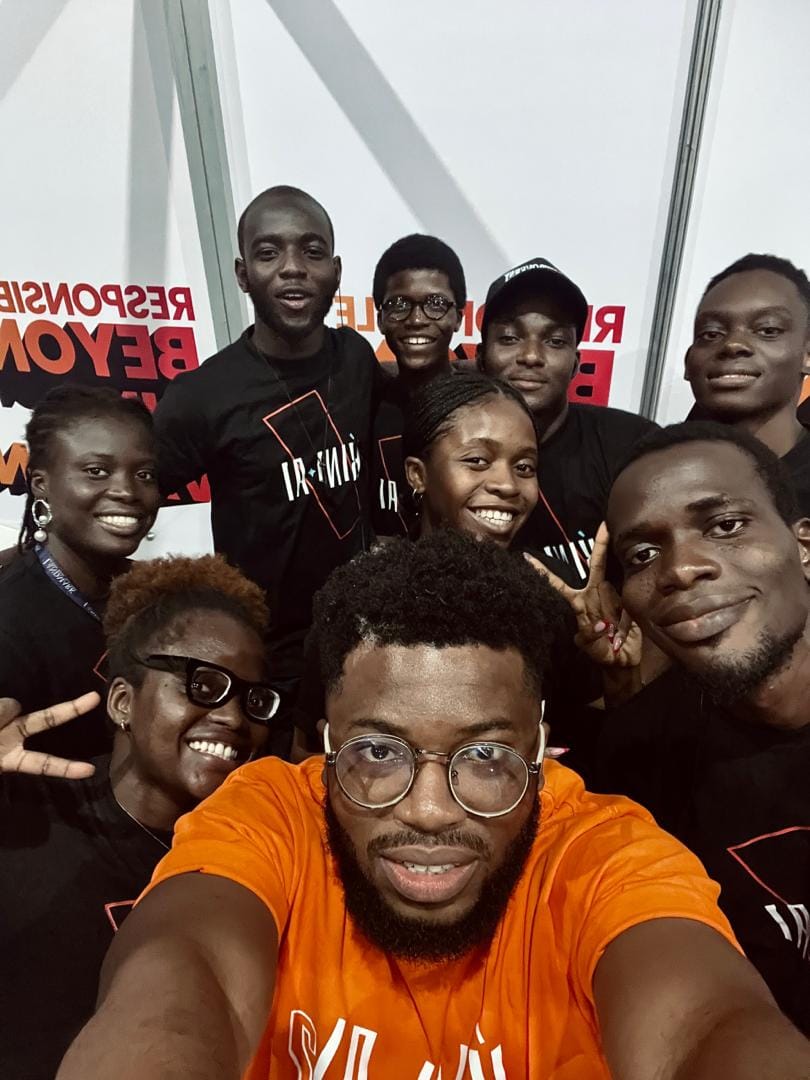
The Kini AI Team at InnovateAI 2026
That last line was not a passing remark; it was the defining undercurrent of the event. Across keynotes, technical sessions, and panel discussions, the emphasis moved decisively toward implementation, governance, infrastructure, talent development, and measurable impact.
Here are some of the most significant insights that emerged from InnovateAI 2026:
1. From Wow to How:
The Nigerian AI ecosystem is increasingly maturing. Only a few years ago, the dominant question was, Kini AI? Before we could say Jack Robinson, it evolved into, How do we use it? And now in 2026, the question has become far more complex and far more consequential: How do we scale AI responsibly in Nigeria?
In 2024, we were asking, "What is AI?" By 2025, it was, "How do we use it?" Now, we are asking, "How do we scale this thing responsibly?"
We are graduating from JJC pilot programs to the Senior-man level of architecture: regulation, accountability frameworks, ethical guardrails, and institutional capacity. Nobody is really captivated by what AI can do anymore. We all know or have an idea what it can do, so it is time for us to determine what it should do and how it should do it. You know, writing the rules of the road before actually letting people get behind the incredibly powerful vehicle.
2. The Case For Caution:
One might wonder: “Why are they suddenly shouting about responsibility and ethics? We’ve been using ChatGPT since, nau!"
Well, it’s because the stakes are incredibly higher now. Starting with the economic side, The Director General of NITDA, Kashifu Inuwa Abdullahi put it perfectly when he said: “Trust is the oxygen of the system". In other words, the entire AI system can not survive without trust. Abi, no be so?
Think about it. If you don't trust a person, will you give them your ATM pin? No. If investors don't trust that our AI systems are stable and governed, will they bring their hard-earned Dollars? Zero.
But beyond the numbers and funds, there’s the real, tangible human cost of getting AI wrong. The Director General went on to share a sobering account of how AI, when deployed without guardrails, can have deeply personal and harmful consequences. When you build an AI that’s used for something as deeply personal as emotional connection, you can't afford "Oops, my bad." One mistake can cause real, irreversible harm. So, responsible AI isn't just a fancy nice-to-have like extra meat in your soup —it is the soup itself.
3. Building a Nigerian Framework — Not Importing One
So with stakes this high, what’s the plan? What’s the solution? Rather than defaulting to borrowed models, conversations at InnovateAI 2026 answered this question by pointing toward a distinctly Nigerian framework anchored on three core pillars: inclusivity, accountability, and sovereignty.
Inclusivity means building AI systems that understand Nigeria in its full complexity. If the AI doesn't know what "O l’enu gan" means, is it really our AI? Understanding Nigerian local languages and context should be baseline requirements for AI relevance in our country.
Accountability demands clear lines of responsibility. There has to be someone we answer to and someone to hold responsible when systems fail. Transparency and accountability have to be engineered into the design and deployment of AI in Nigeria.
Sovereignty requires that Nigeria participate actively in shaping global AI standards rather than passively adopting them. The world is currently writing the Bible of AI rules. If Nigeria is not at that table, we go just dey carry last and doing “Yes sir” to whatever they tell us.
Together, these three pillars form the scaffolding for a resilient ecosystem.
4. The Voices of Society
There were moments at the conference where the speakers stepped away from the high-level policy discussions and brought everything right down to earth. Opportunities were given to the very people this technology is actually supposed to serve. And everyone in the room realized that at the end of the day, responsible AI is more about its real-world impact than what a developer in a lab thinks.
Nothing for us without us.
Stephanie Edgar, a disability advocate from the Mastercard Foundation, distilled inclusive design into the four simple words above and below: “Nothing for us without us.” Her intervention reframed accessibility as a foundational principle. She was basically saying we have to bake accessibility into the core of our design from day one, not just slap it on later. And critically, we have to have people with disabilities in the room co-creating the technology from the very start.
Equally compelling was the perspective from the next generation. Omo, our children are sharp o! Students from Bambini articulated a vision for AI in education that moves beyond automation. They don't want an AI that just gives them the answers. That one creates an illusion of learning. What they want is an AI that prompts them with better questions.
Together, these voices underscored the central truth that responsible AI is not defined solely by technical aspirations and compliance, but also by the needs of the people and its impact on those people.
5. A Call to Action
So, all of this - these conversations, these powerful quotes, these frameworks - all boils down to a call to action. This new era is marked with an increasing urgency that puts an end to conferences without consequences.

As emphasized by Dr Stanley Jacob, President of FIntechNGR, the value of dialogue is measured by what follows it. The ideas discussed cannot die in the conference hall. Frameworks must translate into policy. Commitments must crystallize into investment. Principles must materialize as enforceable standards.
The value of diaogue is measured by what follows it.
We can describe the future as eloquently as we want, but that is not what will put us up there in the AI ecosystem. We have to decisively build that future.
KINI BIG DEAL (Why Does this matter)
We don talk talk talk! The koko of the matter is that this is no longer the time to be amazed by AI. Now is the time for us to demand and build how it does the amazing things.
Stay curious, stay ahead, and remember: the future is not something that happens to us; it’s something we create with our own hands (and some very smart code😉).
Author’s note: This is not a sponsored post, as it expresses my own opinions.
About Me
I'm Awaye Rotimi A., your AI Educator and Consultant. I envision a world where cutting-edge technology not only drives efficiency but also scales productivity for individuals and organisations. My passion lies in democratising AI solutions and firmly believing in empowering and educating the African community. Contact me directly, and let’s discuss what AI can do for you and your organisation
Subscribe to cut through the noise and get the relevant updates and useful tools in AI.
Reply