- Kini AI
- Posts
- We Trained Dozens of Teachers
We Trained Dozens of Teachers
Here is the new reality of the Nigerian classroom

Olayemi Oluwakorede
May 07, 2026
Ẹ káàárọ̀ o! Good morning.
In a space as fast-moving as Artificial Intelligence, staying grounded is the only way to keep from being swept away by the hype. We have been on the ground — and this is what we found.
The AI space is moving so rapidly that it is fundamentally rewriting so many unspoken rules of our society — starting with the classroom.
The End of The All-Knowing Teacher
For decades, the Nigerian classroom has operated on the golden rule that the teacher is the smartest person in the room.
They were the walking encyclopedia and the final bus stop for every “Sir, why?” and “Ma, how?” Even at home, if your parents couldn’t solve your math homework, the standard response was: “Go and ask your teacher tomorrow.” The teacher was the expert and the custodian of all academic knowledge.
But today, the accessibility of Artificial Intelligence has created a reality that is as exciting as it is scary: The teacher is no longer the primary source of knowledge. A student can ask a chatbot to explain photosynthesis in Pidgin English and get an answer clearer than their textbook in three seconds.
This looks progressive on the surface but it hides a massive risk we call The Illusion of Learning.
You might remember our review of that MIT study where students who used AI for everything thought they were mastering the topic, but couldn’t recall a single thing they ‘wrote’ just an hour later.
We are heading toward a world where the traditional teacher risks becoming obsolete, and the student becomes a dependent passenger who can't think without a prompt.
This is why we built Project 1 Million
We have a clear mission at Kini AI to democratise access to and use of Artificial Intelligence in Africa. But democratisation without education is a recipe for dependency. We can't take AI out of the educational system — or out of our workplaces, our businesses, our homes — so we have to change how AI works inside all of them.
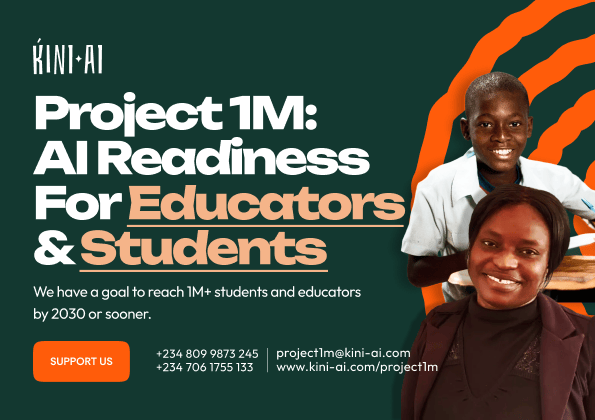
That is why we officially launched Project 1 Million — our mission to educate and sensitize one million people across Africa in AI readiness by 2030.
Who is Project 1 Million (P1M) For?
Project 1 Million includes but isn’t limited to schools and classrooms. It has four tracks:
Educators and Students — training teachers to move from being lecturers to being navigators, and helping students understand that AI is a tutor, not a ghostwriter
Small Business Owners (SMEs) — equipping local business owners with practical AI tools for marketing, customer communication, and operations so that the AI economy doesn't bypass them.
Women and Caregivers — community-based learning models designed for economic empowerment, career re-entry, and independence through AI literacy.
People with Disabilities — inclusive training built around multi-modal delivery and reduced cognitive load, so that AI becomes a tool for independence, not a barrier.
Four communities of one million people are tied to our one goal that no Nigerian — no African — is left behind as the world changes around them.
The First Phase Six Schools
Now, a goal like that is the kind of thing that usually starts with a big, expensive press conference, fancy banners, and plenty big big English. But we skipped that to start where the impact is real: six government schools.
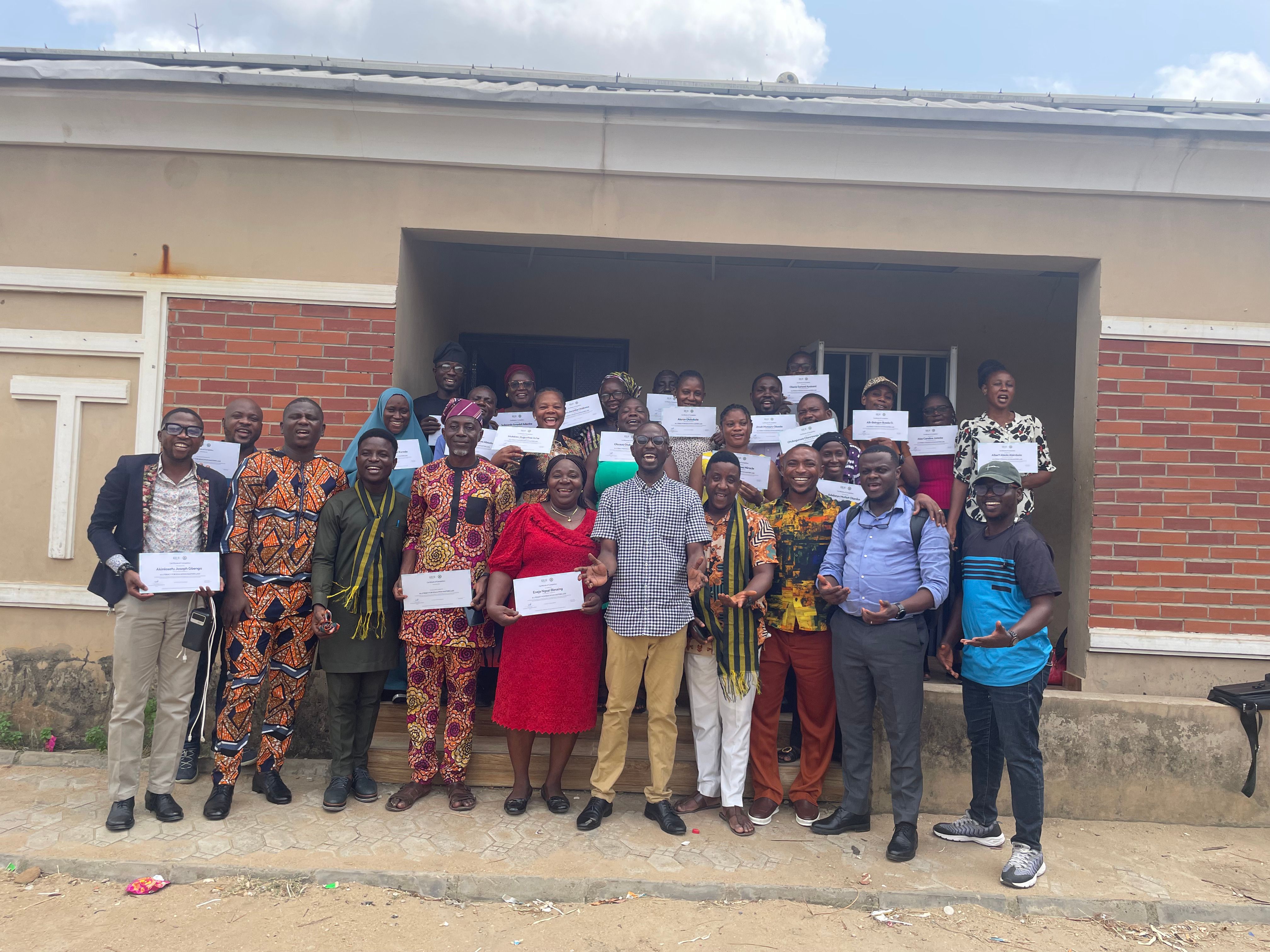
Our focus was the teachers. We certified 80 teachers in AI pedagogy — walking them through a prompting framework to help them automate the grunt work (lesson plans, grading rubrics, assessment templates) so they have more time for the one thing AI cannot replace: actual mentorship. Our certified teachers — including Akwa Temitope Elizabeth, Towolawi Ayeosemitan John, and Adeleke Saheed Bimbola — are already reporting that they save 5 to 10 hours every week on administrative tasks. But more importantly, they are reclaiming their authority as the most essential navigator in the classroom.
We also engaged with the students — not to train them, but to listen to them. Through questionnaires and interviews across all six schools, we spoke with 300 students to understand where they actually stand with AI: how they use it, what they know, what they assume, and what nobody has ever taught them. What we found confirmed that the curiosity is already there. It’s the framework that’s missing.
Our certified teachers —including Akwa Temitope Elizabeth, Towolawi Ayeosemitan John, Adeleke Saheed Bimbola —are already reporting that they save 5 to 10 hours every week on administrative tasks. But more importantly, they are reclaiming their authority as the most essential pilot in the classroom.
We even closed the sessions with a cultural remix. We took the classic Iwe Kiko anthem and gave it an AI upgrade, because education in 2026 demands a new song:
Ìmọ̀ AI ni iṣẹ́ òní. Ẹni tí kò ṣiṣẹ́, yóò wa lẹ́yìn. Iwe Kiko , láìsí AI, kò pé o, kò pé o…
AI knowledge is the work of today. He who does not work, will be left behind. Education, without Artificial Intelligence, is not complete... "
KINI BIG DEAL (Why Does This Matter?)
Project 1 Million is already in motion, and the goal isn't just to make people tech-savvy. The goal is to ensure that as the world moves toward 2030, no Nigerian classroom is left in 1999 — and no Nigerian business owner, no woman re-entering the workforce, no person with a disability is told, even by silence, that this AI revolution was not built for them.
It was. We are making sure of it.
Author’s note: This is not a sponsored post, as it expresses my own opinions.
About Me
I'm Awaye Rotimi A., your AI Educator and Consultant. I envision a world where cutting-edge technology not only drives efficiency but also scales productivity for individuals and organisations. My passion lies in democratising AI solutions and firmly believing in empowering and educating the African community. Contact me directly, and let’s discuss what AI can do for you and your organisation
Subscribe to cut through the noise and get the relevant updates and useful tools in AI.
Reply